The heritage of the Bedouin of Matrouh and of Siwa Oasis: tribes and customary law, weddings and dress, poetry, music and folk dance, Bedouin and Siwan cooking, and traditional crafts.
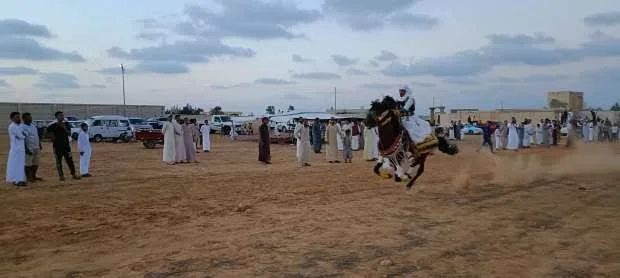
In the Bedouin world of Matrouh, horses are part of every celebration: wedding races, festivals, the welcome of guests and the commemoration of Wadi Majid. Meet the hardy “Moroccan” horse of the Western Desert and the rich vocabulary the tribes use for their horses.
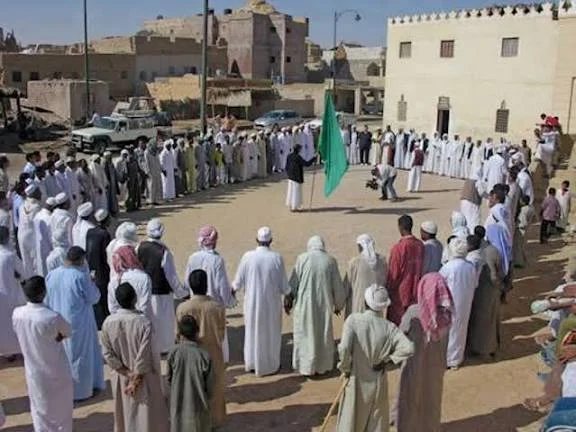
Every October, when the moon is full and the dates and olives have been harvested, the men of Siwa leave their homes for three days on Gebel Dakrour. They settle quarrels, chant dhikr and share one great meal. The story of Siwa’s best-loved festival.
In the summer of 1912 the Cairo magazine Al-Manar published a rare list of the Senussi zawiyas on the caravan road west of Alexandria: their sheikhs, the distances between them, and how they worked as free inns for travellers. A document that maps Matrouh a…
For half a century Matrouh’s Copts belonged to the vast diocese of Beheira, Matrouh and the Five Western Cities. In 2025 Marsa Matrouh became the seat of a diocese of its own, with its first liturgy held at the Church of the Virgin Mary.
On 31 May 1991 the words "This is Matrouh Radio" went on air for the first time. The story of the governorate's radio station: its founders, its Bedouin heritage programmes, its Siwa studio, and its role from El Hamam to Salloum and Siwa.
In the heart of Marsa Matrouh stands a five-storey cultural building with a library of thousands of books, a theatre and a museum of Bedouin and Siwan heritage, alongside seven culture palace sites from El Hammam to Siwa. Where to find culture in Matrouh.
When a Siwan woman leaves her home she wraps herself in the tarfutit, a blue-and-white shawl covering her from head to toe. Beneath it is a dress embroidered in five colours, each with a meaning. Discover Siwan women's dress, its embroidered symbols and jewellery.
Founded in 1975, the Matrouh Folk Arts Troupe has taken stick fighting, Bedouin tents and folk song to festivals in Germany, Poland, Italy, Algeria, the Philippines and beyond. Discover the troupe, its shows and where to see it in summer.
The Awlad Ali are the largest tribe of Egypt's northwest coast. They came from the Jebel Akhdar in Cyrenaica in the 17th century, divide into the Red and White Awlad Ali, and range from Salloum to Beheira. Discover their history, branches and dialect.
A Siwan wedding traditionally lasted seven days, with the bride in a different dress for each stage, beginning with a bath at Tamusi spring where she removed the silver disc worn by unmarried girls. Discover the stages of the traditional Siwan wedding and what has…
Born in Matrouh in 1948, he studied the oud through to a doctorate on Bedouin music, then in 1988 launched the "Lolaki" phenomenon, which sold some 6 million copies. Discover the life of Ali Hamida, the voice of Matrouh.
In Siwa people sing on a pentatonic scale, and men dance in circles to a cylindrical drum called the "tubil" and maqruna reed pipes. Discover Siwa's folk instruments, the zaggala dance, and children's songs and games.
Five major tribes live in Matrouh, branching into some 45 sub-tribes: the Awlad Ali, White and Red, the Gumay'at, the Qat'an, the Sanana and the tribes of Siwa. Discover their branches and how they are spread across the governorate.
Near the towers of New Alamein, a 4-km circular track hosts hundreds of racing camels from Sinai, Upper Egypt and Matrouh, ridden by robot jockeys and traditional riders. Discover camel racing at El Alamein and how it brought Matrouh back to raising camels.
Each autumn Matrouh's falconers head deep into the desert with the bird migration, pitching tents, building pigeon towers and setting snares in hope of catching a peregrine. Discover the falcon passion of Matrouh's Bedouin.
Welcome to MatruhTravel 👋
Sign up for free to save your favourite places, plan your next trip, list or browse items for sale and rent, and message sellers.