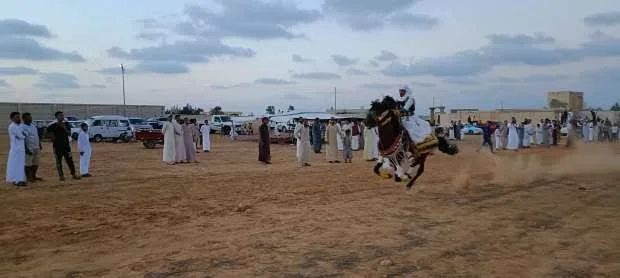
For the Bedouin tribes of Matrouh, the horse is more than a means of travel. It is a companion in journeys, celebrations and, in the past, in war, and horsemanship has long been seen as a measure of courage. Children learn to ride young, and with it the care of horses and the knowledge of their lineages.
Races at the wedding
Horse races are among the highlights of a Bedouin wedding in Matrouh. “We invite riders from all the towns and villages of Matrouh,” says Hagg Eid Bouelhamas, an elder of the Qanashat tribe, “and everyone comes to take part,” while crowds of tribesmen gather to watch the races and the riders’ displays. Horse displays also feature in festivals, in the welcome of the governorate’s guests and in the commemorations of the Battle of Wadi Majid.
The “Moroccan” horse
Among the horses that take part, the tribes prize the “Moroccan” horse, a horse of Moroccan origin that has lived in the Matrouh desert and adapted to its nature and climate. It withstands rain, dust storms, strong winds and rough rocky ground, and it was the mount of the ancestors in their wars.
Breeders look for an ideal build: a clearly arched upper neck that makes the reins easy to handle, small ears standing upright, wide eyes, and a tail carried at a right angle with abundant hair.
A first festival
To revive this heritage, the first equestrian festival in Matrouh was held at the track of the rider Rizq Bou Obeid, with 30 riders and large crowds. Its commentator, Hagg Saleh Mohareb El Qasimi, summed up its spirit: horsemanship, he said, is not only riding horses, but the manners of the horseman, his courage and his honesty.
What the Bedouin call their horses
The Bedouin dialect of Matrouh has a rich vocabulary for horses. Dr Hamad Khaled Shoaib, head of the governorate’s heritage committee, records among others:
- Kut: a horse of strong build.
- Jinjan: a fine, generous horse.
- Sha’nan: one that struts as it walks.
- Midmar: a lean horse.
- Nuqmar: full of life and energy.
- Dayil: slim in the belly.
- Quntir: of massive build.
Mares have their own names: Shalluq, a mare with neither stallion nor foal; Shaliq, a mare seeking a stallion; Shu’a, beautiful to look at; Sulala, of noble descent; and Salwa, graceful of limb.
Frequently asked questions
When do horse races take place in Matrouh?
Above all at Bedouin weddings, and also at festivals, official welcomes and the Wadi Majid commemorations.
What is the “Moroccan” horse?
A horse of Moroccan origin, adapted to the climate and terrain of the Matrouh desert.
Where was the first equestrian festival held?
At the track of the rider Rizq Bou Obeid, with 30 riders.


