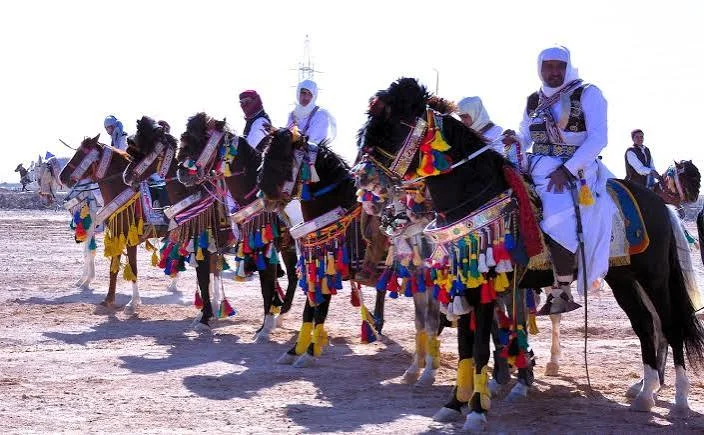
In Matrouh’s Bedouin lands a wedding is not just a family affair but a social gathering of every branch of the tribe, attended by families from other governorates and sometimes from abroad, with an open invitation to anyone who wishes to come.
The stages of marriage
Marriage among Matrouh’s tribes is a collective act involving both families, sometimes the whole tribe, in six stages:
- The proposal.
- The shoofa: the groom sees the bride according to custom.
- The dowry: agreed between the families.
- Sharing the costs between the parties.
- The henna night.
- The wedding night, or “saff”.
The wedding days
- Length: one to three days.
- Venue: in the desert, in Bedouin houses, pavilions and tents.
- A double celebration: the groom celebrates with friends and relatives in a tent, while a pavilion is set up for the bride with her family and friends elsewhere.
- Food: everyone sits on the ground to eat, rich and poor, old and young alike.
- Animals as gifts: neighbours and cousins give the host a sheep; a whole tribe may arrive with a camel. These gifts are returned at other occasions.
Horse races
One highlight of Matrouh’s Bedouin weddings is desert horse racing. Horsemen are invited from across the governorate and parade their decorated horses in full Bedouin dress while the tribes gather to watch. The best-known breed is the “Maghrebi horse”, adapted to Matrouh’s desert, tolerant of rain, dust storms and wind, and once relied on in war.
The night of the “saff”
The saff, or “Bedouin wedding night”, is the climax, following the big night of celebrations. It is a public announcement, never conducted in secret:
- Fires are lit around the wedding site to signal the groom’s coming.
- The procession: the family’s elders escort the groom from his diwan to the bride’s house, on camels or on foot, amid Bedouin verse, the rababa and ululation, sometimes with a “radida”, a poetic exchange between two sides.
- The zayyana dance: the women of the bride’s family welcome the procession with songs and the traditional zayyana dance.
- The announcement: after the couple enter, an elder comes out to tell the guests that “the saff is done”.
- The saff supper: a great feast for the men, usually of slaughtered animals and especially camel meat, served in circles overseen by tribal notables.
Families take pride in the number of animals slaughtered as a sign of generosity, remembered in the “family record”. A researcher in Bedouin heritage at Matrouh University describes the saff as declaring that the bride is now in the groom’s care and that the two families have entered a new bond.
Poetry and dance
- Poetry: folk poets take turns with verses of blessing, pride in lineage and chaste love; some have become wedding songs.
- The hajjala: a dance in which the dancer sways side to side like a partridge, while young men split into two teams, each leader offering a verse, and the best poet wins.
Frequently asked questions
How long does a Bedouin wedding in Matrouh last?
One to three days.
What is the “saff”?
The wedding night, when the tribe publicly announces the marriage complete, followed by a great feast called the saff supper.
What is the Maghrebi horse?
A horse breed adapted to Matrouh’s desert, used in Bedouin wedding races.