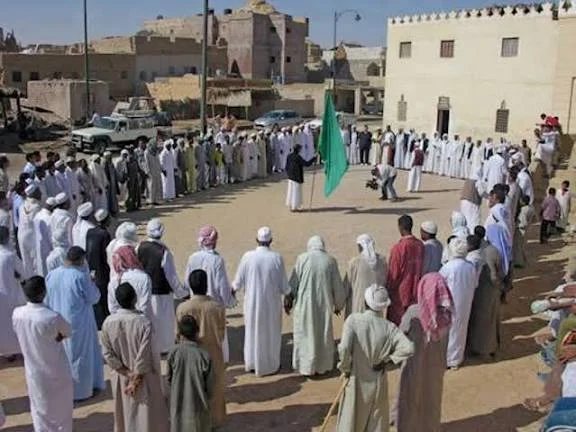
Siwa has its own language, and its own music. Song comes first and instruments follow; melodies rest on the pentatonic scale, resemble the folk tunes of the Libyan coast, and have clear rhythms that researchers link to Central Africa.
Siwa’s folk instruments
- The Siwan drum, “tubil”: Siwa’s most important instrument, a cylinder about 50 cm long with two stretched skin heads, made from local materials.
- Maqruna: a reed wind instrument in three types by the number of holes per pipe: sittawiya (six), khamsawiya (five) and rub’awiya.
- Shabbaba, “tiga’bat”: a metal tube about 50 cm long with four holes, blown from the front at an angle.
- Tar or daf: the main frame drum, a light wooden hoop with stretched skin giving two tones depending on where it is struck.
- Two palm-rib sticks: used to keep rhythm.
The zaggala dance
“Zaggala” was originally the name of a group of strong Siwan labourers who farmed the land of the wealthy; the name later became tied to dance. Siwan dance is performed by men only.
Its forms
- Solo: one man dances in the middle of a half-circle of seated people.
- Group: men move in a large circle around the musicians and singers, answering the lead singer.
- Singers and players sit in a small circle or half-circle, singing and clapping in time.
The movements
- All movement is circular, into and out of the circle or around the musicians.
- Knees bent and body leaning forward, moving close to the ground; even small jumps look like hops or shuffles.
- The dancer holds both ends of a shawl wrapped around his waist.
- Performance is free, changing with each dancer’s feel for the music.
Song in Siwan life
- Folk songs are sung together by men and children, and preserved and passed on by women.
- Songs accompany occasions and daily work, including weddings and celebrating a newborn.
- At the Siyaha festival on Gebel Dakrour, Sufi hadra gatherings feature chants, hymns and ordered movement.
Children’s songs and games
- “El-Taalab Fat Fat”: the game known across Egypt, to which Siwan children added sung lines in Siwi and their own tune.
- “Barila Barila”: a singing game for girls aged 6 to 11, about engagement and jewellery.
- Folk riddles: about the fox, olive trees and date clusters.
Who documented Siwa’s music?
Researcher Brigitte Schiffer documented the region’s folk instruments in a 1933 thesis, translated into Arabic in 1998; Samir Naguib studied Siwan music in 1965; and Safwat Mohamed Fathi recorded and notated the region’s dances in a 2002 thesis.
Frequently asked questions
What is Siwa’s best-known instrument?
The Siwan drum “tubil”, a cylinder about 50 cm long with two skin heads.
Do women dance in Siwa?
Traditional Siwan dance is performed by men, while women preserve and pass on the folk songs.
What is the zaggala dance?
A circular men’s dance, solo or in a group, around the singers and musicians, with movements close to the ground.