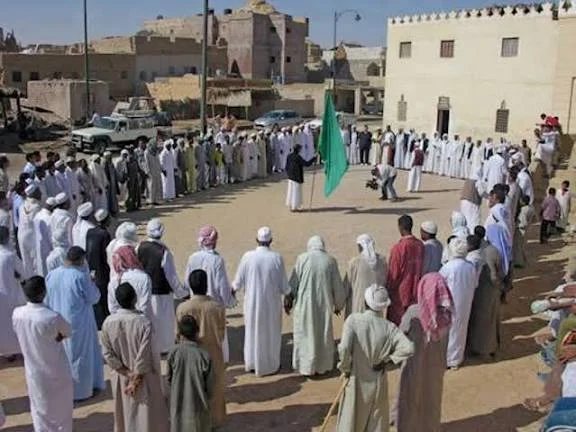
Of all Siwa’s celebrations, the best known is the Siyaha festival, known in the Siwan language as “Isyahat”. It is also called the Festival of Reconciliation and the Harvest Festival.
What “Siyaha” means
Despite its name, the festival has nothing to do with tourism. In its Sufi sense, siyaha means a spiritual journey, a wandering of the heart in the love of God in search of inner peace; for three days the people of Siwa leave their homes and worldly affairs to devote themselves to remembrance of God. Another view holds that the name comes from al-saha, “the square”, because the festival is held in the open ground at the foot of Gebel Dakrour.
When and where
The festival is held over three days on the full-moon nights of October, sometimes slipping into November, after the harvest of dates and olives, the two great crops of the oasis. It takes place on Gebel Dakrour, a chain of hills about 3 km south of Siwa town. The men leave their homes and work and stay on the mountain, in old mud-brick houses or in tents, for the length of the festival.
Reconciliation
At the heart of the festival is reconciliation. In the presence of the elders and sheikhs of the tribes, disputes between families are settled and quarrels that built up over the year are brought to an end. Circles of dhikr and religious chanting fill the nights.
One meal for everyone
Every household contributes meat to a great communal meal. The cooks prepare fatta, bread with meat and rice, and the head cook tastes the broth pot by pot, adding salt and spices. Then the dishes are laid out in the great square before the mountain. No one begins to eat until a signal is given by a man called al-Qudwa, “the exemplar”, who sits at the highest point of the mountain; then everyone eats at once, a sign that the quarrels of the year are over.
The procession of the fourth day
On the morning of the fourth day the people of Siwa set off in a great procession, carrying flags and chanting prayers and praise, from Gebel Dakrour through the farms and streets of the oasis to Sidi Suleiman square, beside the great mosque in the centre of town. The procession marks the end of the festival and the start of a new year free of grudges.
How it began
The festival is said to be about 160 years old, but accounts differ on its origin. According to Al-Ahram, it began in 1285 AH (around 1868), when a sheikh of the Madaniya Sufi order, followed by most Siwans, came from Libya to visit his disciples at a time of conflict between the eastern and western Siwans, and reconciled them. The accounts also differ on his name, given variously as Sheikh Mohamed El Madani, Sheikh Ahmed El Zafer El Madani and Sheikh Mohamed Hassan Zafer El Madani; one of the oasis’s sheikhs even places the reconciliation in the mid-18th century.
Towards UNESCO
In 2025 Al-Ahram described the Siyaha festival as awaiting a place on UNESCO’s lists of intangible heritage.
Frequently asked questions
When is the Siyaha festival held?
Over three days on the full-moon nights of October, sometimes November, after the date and olive harvest.
Does “Siyaha” mean tourism?
No. It refers to a spiritual journey in the Sufi sense, or, by another view, to the square where the festival is held.
Can visitors attend?
The festival is a religious and social occasion of the Siwan community; visitors who come should respect its customs.


