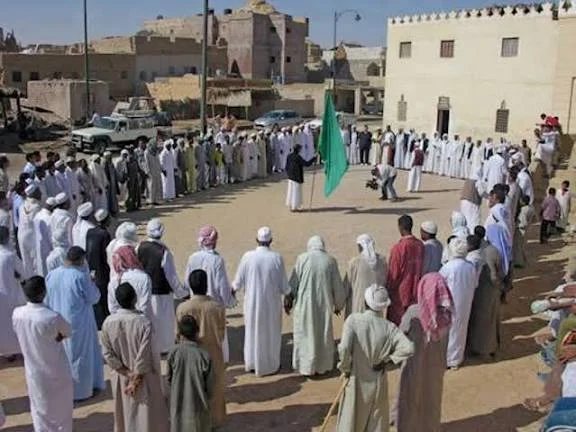
In Siwa a wedding is not a single night. It traditionally lasted seven days, each with its own dress and rituals, and the whole oasis took part. Weddings are shorter today, but they still carry many features of this unique Amazigh heritage.
Before the wedding
- The match: marriages were arranged between families, and a fiqih was sometimes consulted on whether the couple’s names were compatible.
- The proposal: the suitor sent a female relative with a gift of money or clothes; if the girl’s family accepted, he became her fiancé.
- The dowry: a dowry was agreed, with part held back for the wife.
- Preparations: three days before the wedding, the bride’s friends gathered at her house to prepare the feast.
The adrim: the mark of unmarried girls
Unmarried Siwan girls wore a large silver disc called the adrim (shebeka in Arabic) on a heavy silver torque called the aghraw, a sign that they had reached marriageable age. On the eve of her wedding the bride removed it and gave it to her family, for a younger sister or relative to wear.
The bride’s bath at Tamusi spring
In the late afternoon before the wedding, girls and women took the bride, in her finest clothes, to Tamusi spring, whose water is used only for rituals, never for drinking or housework. There:
- The bride removed her silver adrim.
- She bathed in the spring.
- She changed into another dress while a friend plaited and scented her hair.
Some accounts say the procession stopped on the way back at the shrine of Sidi Suliman, Siwa’s patron saint, to recite the Fatiha. On the way, the groom’s female relatives met the procession with gifts of money, which an elderly woman collected in a silk scarf, remembering each giver.
The henna night and the procession
- Evening: the groom’s female relatives came to the bride’s house led by children carrying candles; the bride sat in the centre while her hair was combed and scented and the women sang to her.
- Morning: the groom’s relatives came to fetch the bride; her relatives staged a mock quarrel to keep her until a man of her family intervened. A woman then carried the bride on her shoulders to the groom’s house.
- At the new home: the carrier jokingly “sold” the bride to the groom, though nothing was paid, and married life began.
Seven days, seven dresses
Siwan bridal dresses are among Egypt’s finest embroidery:
- Days one and seven: a silk dress striped in green, orange, red, white and black.
- Day three onwards: a white dress richly embroidered around the neck opening, with mother-of-pearl buttons and stitched rays like the sun’s.
- Evening of day seven: the bride returned to her day-one dress and wore her jewellery.
- After the wedding: a black embroidered dress worn in the first months of marriage.
Other sources say the seven days matched seven dresses of different colours: sheer white, red, black, yellow, blue, pink and green.
The Siwan wedding today
Since the mid-20th century Siwan weddings have shortened to two or three days, with fewer dress changes, and the white embroidered dress has become the favourite. Yet big weddings still revive the old spirit: at one big wedding reported in the press the celebrations lasted a full week, and residents estimated some 40,000 guests from Siwa, across Egypt, Libya and Saudi Arabia.
A note for visitors
Weddings in Siwa are family occasions, and Siwan society is conservative. Never photograph women or the bride without explicit permission, and if invited, follow your hosts’ lead.
Frequently asked questions
How long does a Siwan wedding last?
Traditionally seven days; since the mid-20th century usually two or three.
What is Tamusi spring?
A Siwan spring whose water is used only for rituals; the bride bathes there and removes her adrim on the eve of her wedding.
What is the adrim?
A silver disc worn by unmarried Siwan girls as a sign of marriageable age, removed on the eve of the wedding.