Before factories, Matrouh's Bedouin women spun Barki sheep's wool by hand, dyed it with pomegranate peel and indigo, and wove it on a ground loom into kilims and hawaya. Discover the craft's stages and vocabulary, and the El Qasr workshop trying to save it.
Every early May, sheep shearing in Matrouh's Bedouin lands becomes a festival: volunteer relatives, a role for each, verses chanted as they work, and a feast of mutton. Discover the jalama season, its rituals and its vocabulary.
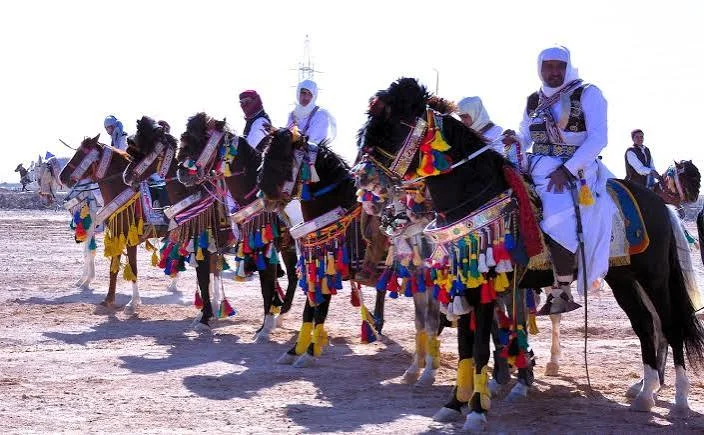
A wedding in Matrouh's Bedouin lands gathers the whole tribe: a tent for the groom and a pavilion for the bride, animals given by neighbours, horsemen racing Maghrebi horses, then the night of the saff, when the tribe announces the marriage complete. Discover its stages…
The rain-harvesting wells and cisterns the Romans began are still at work in Matrouh, now on a new scale: thousands of dams, wells and basins, hundreds of Roman wells cleaned, and olive seedlings handed out. Discover the northwest coast's largest rain-harvesting project.
Barki sheep are a local breed of the northwest coast's Bedouin rangelands, originating in Barqa in Libya, able to withstand drought and graze sparse desert plants, and famous for lean red meat. Discover the breed, its importance to the Bedouin, and what threatens it.
In March 2020 three products from Matrouh became the first geographical indications registered in Egypt: Sultani figs, Barani grapes from Sidi Barrani, and Matrouh olive oil. Learn what a geographical indication means, about each product, and why it matters to farmers and buyers.
The Western Desert railway began under Khedive Abbas Helmy II, reached Marsa Matrouh in 1936, carried the armies of World War II, and has 37 stations with classic architecture. Discover the story of the "Khedive's railway" to Matrouh.
Along the Matrouh coast are ancient wells and cisterns dug to store rainwater, some dating to Ptolemaic and Roman times, and the Bedouin still use them. Discover their story, the wells of the Qasr area, and today's projects to rehabilitate them.
Beneath the sands of the northwest coast lie millions of World War II mines and unexploded ordnance, over an estimated 2,680 km². Discover the scale of the problem, its victims, clearance efforts since 2006, and what visitors need to know to stay safe.
Erwin Rommel, the commander his enemies called the "Desert Fox", led Axis forces in North Africa from 1941 to 1943, sweeping across Matrouh to El Alamein before being defeated there. Discover his Western Desert story, his stops in Matrouh and his end.
Every autumn millions of migrating birds cross Egypt's skies, reaching Matrouh's coast from mid-August to late October. Discover the best-known species such as quail and turtle doves, the Bedouin traditions of the season, hunting permits, and why protecting migrating birds matters.
Matrouh is Egypt's fig capital: some 60,000 feddans of rain-fed fig orchards, annual production of about 137,000 tonnes, the Barshoumi as its best-known variety and a harvest in August and September, alongside olive oil, barley and the cisterns that store rainwater.
Discover the spoken and sung arts of Matrouh's Bedouins: the one-verse ghinnawa with its melancholy tone, the mujarouda that tells a whole story, the call-and-response shtiwa, the maqruna pipe, the Matrouh folk troupe, and Ali Hemeida, the voice who carried Bedouin song across Egypt.
The Qattara Depression in Matrouh Governorate is one of the largest natural depressions in the world, dropping to about 133 metres below sea level and covering more than 18,000 km². A guide to its geography, its role in the battles of El Alamein and the…
Discover the heritage of Matrouh's Bedouin: men's traditional dress from the thawb, malaf and shanna to the white wool jard and the way it is draped, and National Day on 15 December, marking the 1915 Battle of Wadi Majid, with its horsemen's celebrations.
Welcome to MatruhTravel 👋
Sign up for free to save your favourite places, plan your next trip, list or browse items for sale and rent, and message sellers.