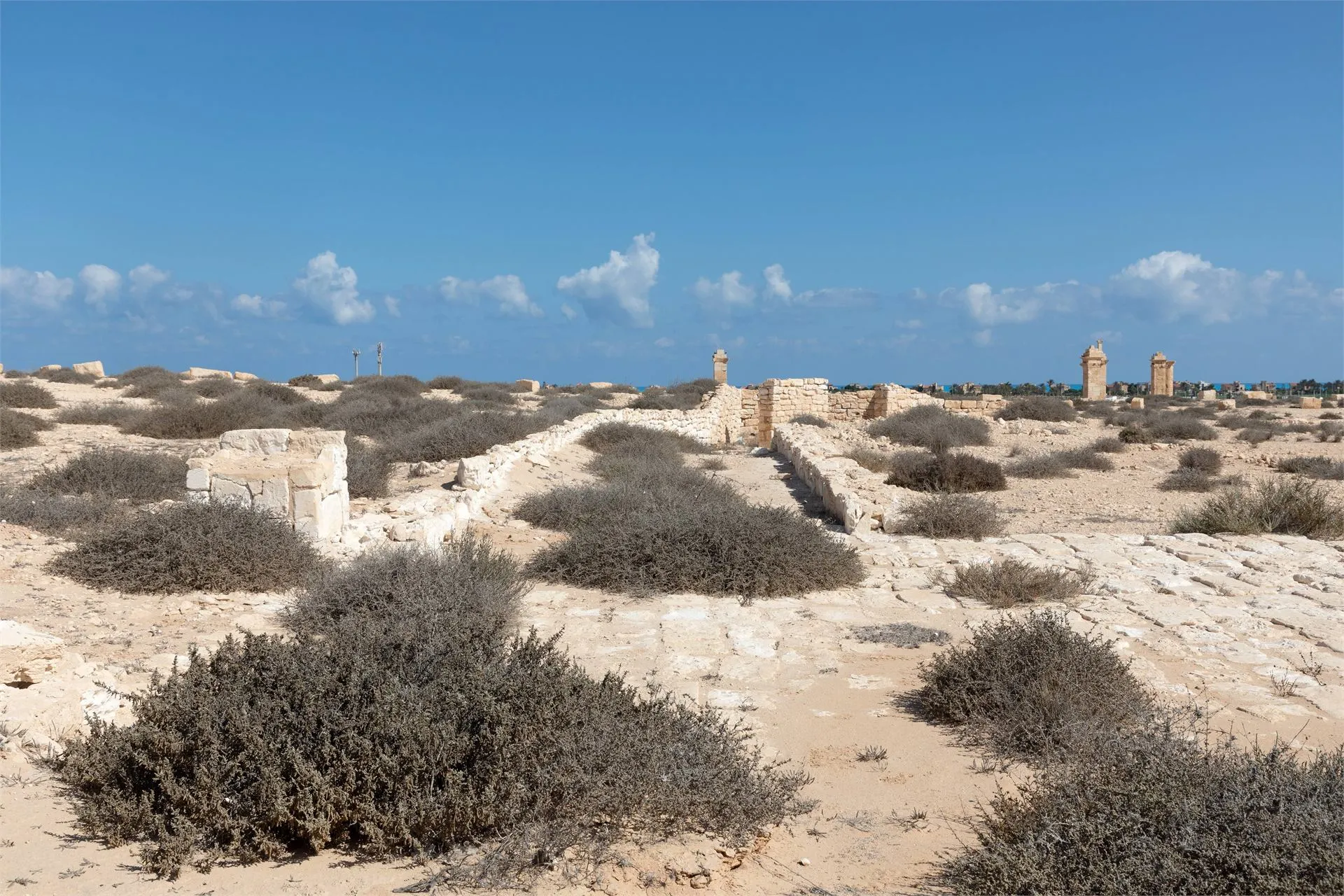
A few steps from the villas and artificial lagoons of the Marina resort stand the columns and walls of a complete ancient town. This was a Graeco-Roman port that lived for some eight centuries, then vanished under the sand until bulldozers uncovered it by chance in 1986. It is most likely Leukaspis, the most important archaeological site on the Alamein coast.
Where is the site?
The site lies within Marina El Alamein, about 5 km east of El Alamein town and about 100 km west of Alexandria. It stretches roughly one kilometre along the shore and about 550 metres inland.
What was the town called?
Archaeologists believe it is Leukaspis, mentioned by the Greek geographer Strabo; some sources also call it Antiphrae. No inscription has yet settled the name, so it remains “probable”.
The town’s story
- Founding: the town arose around the 2nd century BC, in the Ptolemaic period.
- Prosperity: it peaked in the first three centuries AD as a trading stop between Egypt and Libya, receiving goods from Crete.
- Population: some sources estimate about 15,000 people at its height.
- Decline: some researchers link its ruin to the great earthquake and tsunami that struck the eastern Mediterranean in AD 365; limited life continued into the Byzantine period until the 6th century, and the town was never rebuilt.
Discovery and missions
In 1986, while roads were being laid for the Marina resort, the remains of houses and tombs appeared. The antiquities ministry began rescue excavations that year, and the Polish Centre of Mediterranean Archaeology of the University of Warsaw joined; Polish-Egyptian missions have excavated and conserved the site since the late 1980s. Sadly, the ancient harbour area had already been cleared to create the resort’s lagoon before the discovery.
What can you see?
- The central square: a main square lined with colonnaded porticoes, the heart of public life.
- The baths: one Hellenistic and one Roman bath, both restored by the Polish-Egyptian mission.
- Residential quarters: densely built houses around the centre, some with courtyards and columns.
- Two churches: a basilica in the town centre and an early Christian basilica to the south.
- The necropolis: south of the town, dating from the late 2nd century BC to the 4th century AD, with tomb forms unknown elsewhere in Egypt or rarely so well preserved.
The summer 2026 finds
In July 2026 an Egyptian mission led by Dr Eman Abdelkhaleq, director of the area, announced 18 new tombs from the Ptolemaic and Roman periods, bringing the total found at the site since 1986 to 44 tombs.
- 11 rock-cut tombs, averaging about 8 metres deep, and 7 surface tombs built of limestone.
- Burial openings sealed with stone slabs and untouched since antiquity, and a water well later reused for burials.
- A granite sarcophagus about 2.5 metres long with its original lid still in place.
- 24 gold pieces placed in the mouths of some of the dead, including an Eye of Horus amulet.
- An unfinished marble statue, probably of Aphrodite, a tombstone of a seated man holding a bird, an altar with a false-door façade, fragments of a plaster sphinx, and glass and pottery vessels and lamps.
The site today
In September 2010 the government began preparing the site as an open-air museum. A development project now under way includes a visitor centre, pedestrian and electric-car paths, a museum storehouse and an open-air theatre, and is expected to finish in the first half of 2027.
Visiting tips
- Check opening times before you go, especially while development works continue.
- Go early in the morning or before sunset; there is little shade among the ruins.
- Combine the visit with the nearby El Alamein War Museum and war cemeteries in one day.
Frequently asked questions
What is the ancient town at Marina El Alamein?
A Graeco-Roman port town, probably Leukaspis, that lived from the 2nd century BC to the 6th century AD.
When was the Marina site discovered?
In 1986, while roads were being built for the Marina resort.
How many tombs have been found?
44 tombs as of July 2026, including 18 announced that month.


